Variations of the Tom Thumb
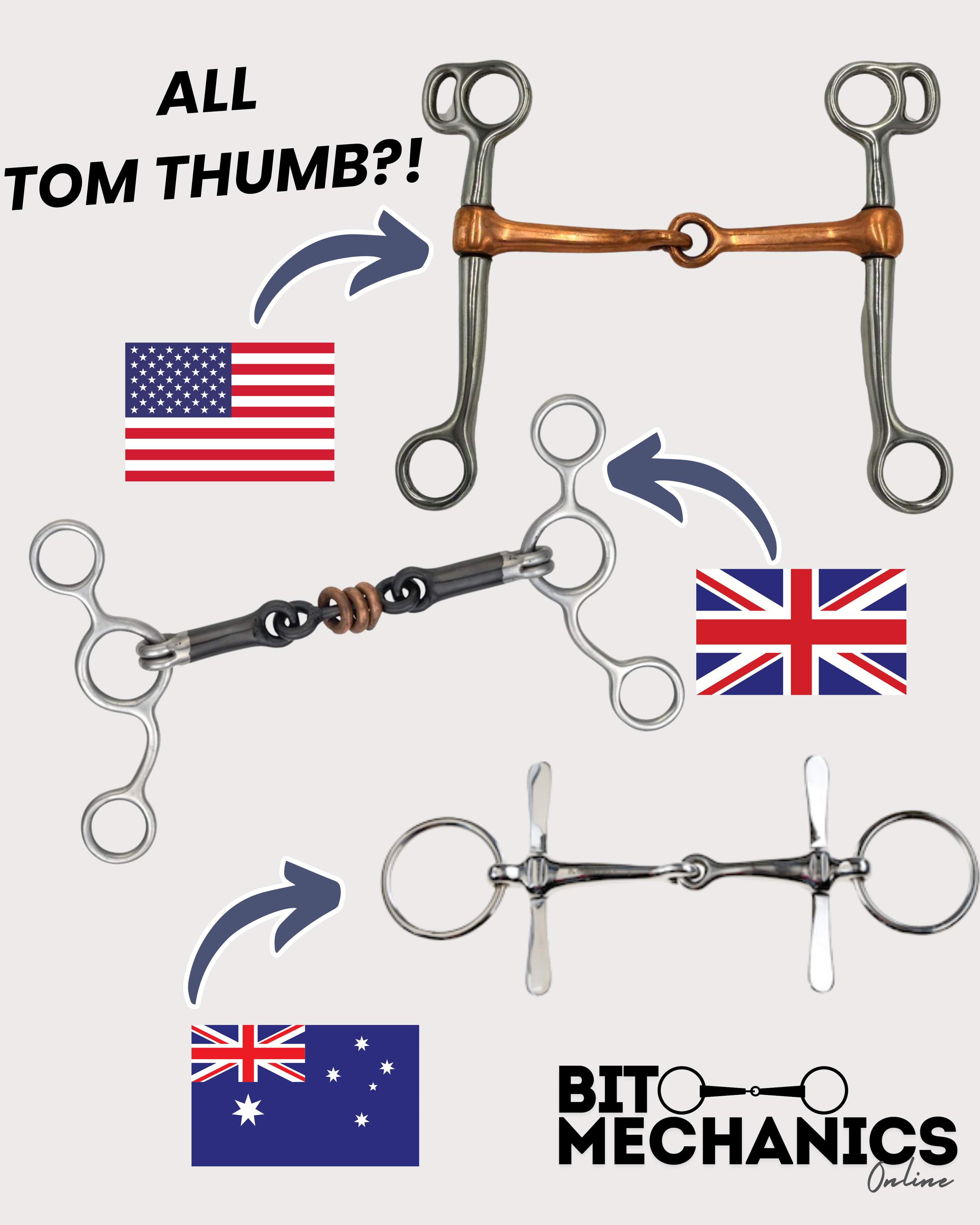
Talking about the “Tom Thumb” bit, particularly on the internet, can be confusing when people are from different nations and have different conceptions of what the bit is.
In the US, the Tom Thumb is a particularly severe bit. It is designed to be used for neckrecking and shouldn’t be used for direct reining. It has straight shanks, (traditionally) a single-jointed mouthpiece, and it’s used with a curb strap. When the rein is engaged, the straight shanks mean there is no pre-signal, so there is immediate pressure in all pressure points of the bit: the tongue, bars of the mouth, roof of the mouth, chin groove, and poll. The single-joint element of the bit causes a nutcracker action in the mouth, particularly when paired with a leverage cheekpiece, causing sharp, intense pressure in the roof of the mouth and a scissor-like action down the sides of the lower jaw. See our article on single-joint leverage bits for a demonstration of this mechanic.
In the UK, the Tom Thumb (known as a Junior Cow Horse in the US or a Pro Trainer in New Zealand) is not quite as harsh as the US version, but it is still a very severe bit, particularly as it isn’t overly common to use it with a curb strap. The mouthpiece is attached in a loose-ring fashion, and so when the rein is engaged, it slides up the ring and rises in the horse’s mouth. The rotation of the cheekpieces when the rein is pulled means there’s a large amount of poll pressure, particularly when not used with a curb strap. This means you get the conflicting signals characterised by gag bits of the mouthpiece asking for the head to rise and the poll pressure encouraging the head to lower.
In Australia, the Tom Thumb is a Snaffle bit very similar to a Fulmer. It has vertical bars that apply lateral pressure to the side of the face, although it is worth noting these vertical bars are not as long as the Fulmer’s. The mouthpiece connects to the cheekpiece in a loose-ring fashion, and without the vertical bars, it would be equivalent to a Loose Ring Snaffle. Unlike the other versions of Tom Thumb, this bit does not have any leverage.